CHA Library
Since 2022 we’ve been building our library with articles, white-papers, educational documents, and opinion-pieces to preserve information and knowledge.
Should We Be Worried About This Hantavirus ‘Outbreak’?
May 08, 2026 - Alan Brough
Full Article
Should We Be Worried About This Hantavirus ‘Outbreak’?
I am sure you all know me well enough by now to know that my unequivocal answer to this question is a resounded NO, as it has been for all the other ‘next pandemic’ health scares we have seen come and go over the last three or so years.
International blogger and outspoken freedom advocate, Sasha Latypova put it bluntly in a post on Thursday, saying, “I am enjoying the sight of a robust and funny public response to the feeble attempts of the pandemic cabal to ignite another round of fear and bullshit with the current “hantavirus” psyop.” And she is absolutely right.
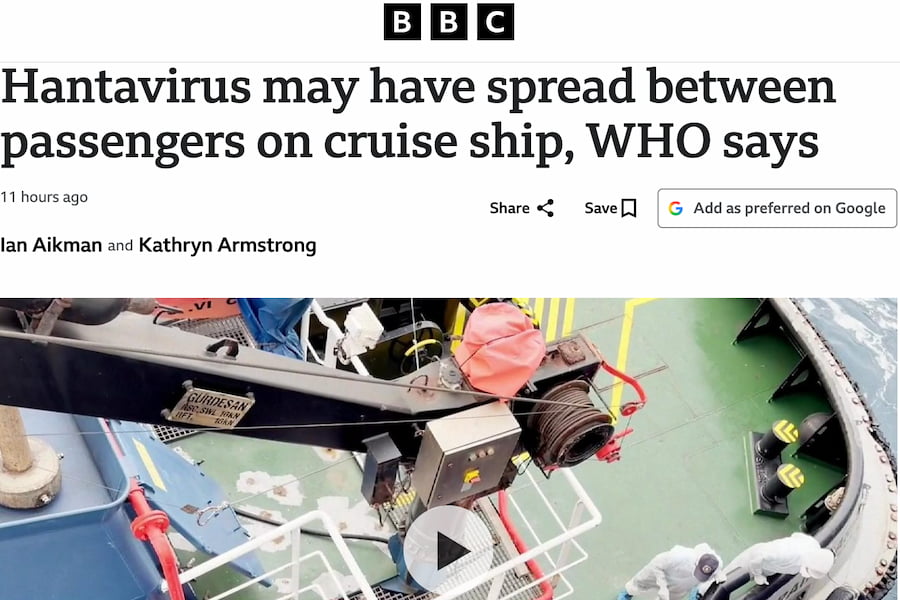
Although most people have never even heard of the hantavirus before, this particular drama all started about a month ago with a reported ‘outbreak’ aboard the MV Hondius cruise ship which is carrying 147 passengers and crew. The ship which is operated by Oceanside Expeditions, was cruising from Argentina with stops in Antarctica, South Georgia, and remote islands like Tristan da Cunha and Saint Helena. Of course this deadly outbreak quickly made global headlines, and the mainstream media are now having a feeding-frenzy around the same old ‘we’re all going to die’ playbook.
On Tuesday, our own CBC ran the headline, “Human-to-human transmission of killer hantavirus suspected in cruise ship outbreak,” with the World Health Organization themselves fully behind this implication of human-to-human transmission, which, under normal circumstances, is extremely rare with hantavirus outbreaks. Commenting on this, Dr. Peter McCullough said, “During the pandemic I recall the WHO and other public health agencies making every wrong move in terms of action steps. Now the same is playing out with the MV Hondius hantavirus outbreak.”
The first question we should ask, as always, is if this outbreak is something we should be worried about, especially as there are currently no approved treatments specifically for hantavirus, and the fatality rate is high – somewhere between 30 and 40%.
Even so, the realistic chances of hantavirus turning into a real pandemic are almost zero – unless, of course, it is a weaponized ‘lab-leak’ and then all bets are off. However, there is not much documented around NBC (Nuclear, Chemical and Biological) laboratories tinkering with hantavirus, so I think we’re okay on that score. As investigative journalist and epidemiologist, Nicolas Hulscher states in his analysis of the situation, “The outbreak is expected to fizzle out fairly quickly.”
However, before we move on with our lives and get back to our more important pursuit of health, wealth and happiness, it is worth sharing some facts about hantavirus so you know why we are not too worried about it.
In contrast to what the CBC claimed in their click-bait headline, Hantavirus Pulmonary Syndrome (HPS), to use it’s full name, is not considered contagious via human-to-human contact, even in close settings like a cruise ship. However, cruise ship cases typically trigger concern because of shared ventilation and close quarters, but hantavirus transmission (for these strains) still requires contact with infected rodent urine, droppings, or saliva, not other passengers.
So, although it is a dangerous disease to humans which, as it progresses, can lead to damaged lung tissue, fluid build-up in the lungs, and serious problems with lung and heart function, it is very, VERY hard to ‘catch.’ Contraction usually depends on people licking or otherwise ingesting rat urine or droppings. Not something most people tend to do very often. Even then the chances are small as in wild rodent populations, typically only 1% to 15% are infected at any given time, most of which don’t show any outward signs of sickness, as rodents are more-so carriers of the virus than victims of it.
Then, of course, there is the question as to whether the problem on this particular cruise ship is really hantavirus or something else. Looking at the news feeds and the reader comments, many people are asking what role 5G (or perhaps 6G which is being trialed on some cruise ships) might have played in this whole ‘outbreak.’
There are two considerations with this theory: Firstly, how are people tested for the virus, and secondly, what are their symptoms? The first red flag is that diagnosis is usually done by using a PCR test, and we all know from the Covid debacle how those results can be misconstrued. The symptoms are also telling: Of the seven confirmed cases on the MV Hondius the symptoms were as follows:
- Fever, headache and mild diarrhoea followed by respiratory distress. This patient died on April 11.
- Mainly gastrointestinal symptoms. This patient died on April 26.
- Febrile illness, shortness of breath and signs of pneumonia. Currently this patient is still in hospital in South Africa.
- Fever, a general feeling of being unwell which developed into symptoms of pneumonia. This patient is currently in hospital in Cabo Verde.
- By early this week, three other passengers with symptoms of high fever and/or gastrointestinal symptoms have been reported and remain onboard the ship.
- Now, we are hearing that the ship’s Captain and Chief Medical Officer are also reporting symptoms, which point to the possibility of rat droppings somehow getting into the food chain, or as Dr. McCullough suggests, perhaps their onboard air purification HVAC system has not been properly sterilized from rodent excrement dust which means it is actually circulating the dangerous virions.
Yet, the majority of these symptoms, especially fever, headaches and flu-like symptoms, are all seen with high EMF and WiFi exposure, and we know 6G (if that was deployed on the ship) will cause more severe, and likely new, symptoms due to its strength and impact on the body. So, it is certainly a possibility that EMFs and/or 5G or 6G could be contributing factors.
At this stage we just don’t know… But we do know that the MV Hondius does have satellite connectivity that provides 1.5 GB of data per day for the passengers, and that additional data can be purchased, which indicates a significant wireless field with excess capacity that covers the entire ship. The ship also has two computer stations available for passenger use.
So is the real reason for all this drama, Moderna’s new mRNA-based hantavirus ‘vaccine’?
Highly likely!
It is no coincidence that Moderna is already collaborating with Korea University to fast-track their new hantavirus “injection” (they haven’t called it a ‘vaccine’ as yet, but that is what they are implying). As a result, it stands to reason that a bit of media hype about a deadly outbreak will go a very long way in getting US and EU regulators to rush through an “emergency use authorization.” No doubt this is all part of the business strategy to boost profits and shareholder’s dividends, given the slump they have seen in Covid booster sales.
As we learnt with Covid, emergency use authorization can only be granted if there is, a) A real threat to public health and, b) No other treatment option. Obviously with Covid they fabricated both, so we can expect the same to happen this time, assuming they can generate enough fear and panic in the population at large – which I personally doubt.
But it is not just Moderna who are working on a hantavirus vaccine. You will be shocked to learn that there are currently thirteen (yes, THIRTEEN!!!) documented hantavirus vaccine and gene therapy programs in active development. They are:
- 6 DNA “vaccines” (which are plasmid DNA gene-therapies, most of which are being developed by the U.S. Army / USAMRIID), many of them “needle-free” jet-injector versions
- 3 mRNA “vaccines” (the one mentioned above being developed by Moderna and Korea University, one being developed by a Chinese research team and one being developed by VIDO Canada)
- 2 viral vector “vaccines” (one being developed by a consortium of UK institutions and the other by VIDO Canada)
- 1 inactivated vaccine (Hantavax — which is already licensed and used in South Korea)
- 1 protein subunit vaccine (being developed by VIDO Canada)
On this, Sasha Latypova writes, “Who could have predicted this!! For a disease with annual mortality of 6, there are now 13 vaccines and other bullshit poison products in development!”
Clearly for us, the one to watch is VIDO Canada. VIDO stands for the Vaccine and Infectious Disease Organization (VIDO) which is a University of Saskatchewan Research Centre. VIDO got national attention back in 2020 when they claimed to be the first laboratory to isolate SARS-CoV-2 in Canada (which is still a bit questionable) and the first Canadian University to have a SARS-CoV-2 vaccine in clinical trials. In 2022 they opened their new Vaccine Development Centre that has manufacturing capabilities for both human and animal vaccines. It is at this Vaccine Development Centre in the University of Saskatchewan campus in Saskatoon that these hantavirus vaccines are being worked on.
Another interesting twist to this whole ‘vaccine’ debate, which is now doing the social-media rounds, is that hantavirus is listed on page 38 of Pfizer’s list of known Covid-19 vaccine side-effects. This opens the possibility that it isn’t a more virulent strain of hantavirus on the Hondius, but is instead greater vaccine-induced susceptibility to the virus within those first few passengers who brought the contagion on board in the first place.
Given all the above focus on mRNA, DNA gene-therapy and viral vector ‘treatment’ options, as is so often the case, there does appear to be a couple of possible ‘safe and effective’ natural ways of treating hantavirus which most of the Big Pharma corporations are resolutely ignoring.
Firstly Ivermectin has a strong track record against RNA viruses, such as hantavirus, so was quickly put forward as a possible treatment. Predictably, this was as quickly rejected by The World Health Organization who just went on record to claim that ivermectin is “not an effective treatment for hantavirus,” fully dismissing the large body of research suggesting the opposite is in fact likely true. As Nicolas Hulscher points out, this is no surprise given that Bill Gates is now the WHO’s top funder.
There is also equally compelling evidence that the equally-maligned Hydroxychloroquine would be an effective preventative treatment. A 2021 peer-reviewed study in Frontiers in Cellular and Infection Microbiology directly evaluated chloroquine against multiple hantaviruses, including the Andes virus — the most clinically relevant strain and the one implicated in the recent cruise ship outbreak. The key finding comes from the Andes virus model: “In the gold-standard Syrian hamster model of hantavirus pulmonary syndrome (which closely mimics severe human disease), chloroquine produced a striking survival benefit. When administered continuously before infection.”
Then there is ‘Griffithsin.’ In a recent evaluation on this, Nicolas Hulscher noted, “Some early-stage scientific work has turned up an intriguing natural candidate that deserves attention. … [This] compound is Griffithsin (GRFT), a non-toxic, natural protein originally isolated from a species of red marine algae. In a 2020 laboratory study, researchers at the CDC showed that Griffithsin was remarkably effective in cell culture against two of the most important New World hantaviruses, the Andes virus and the Sin Nombre virus.”
Early research findings have shown that Griffithsin reduced hantavirus infection of cells by up to 95% and slashed the infectious viral load by more than 99.99% — a greater than 10,000-fold drop. It appears to do this by physically blocking the virus from entering human cells through its binding to specific sugar molecules on the viral surface glycoproteins.
Of course all of Bill Gate’s and Moderna’s billions of dollars of R&D money, won’t be used to explore this more natural option, especially when their own patented and, no-doubt, highly profitable vaccine is on the cards instead.
However, my advice to you remains: First do not worry about this, it is all just media-driven fear-porn, and secondly, always do your best to avoid rat droppings!
Meanwhile, on Monday, (May 11th) the ill-fated MV Hondius is scheduled to dock in Granadilla, Tenerife, under strict quarantine protocols. Consequently, over the next few days we can expect a dramatic media crescendo furthering the new pandemic hype and Big Pharma’s gleeful anticipation of another vaccine windfall.
Alan Brough
Sources for this article include:
https://www.thefocalpoints.com/p/natural-red-algae-protein-slashes
https://controlstudies.substack.com/p/hantavirus-hoax
https://www.thefocalpoints.com/p/who-blunder-imperils-remaining-passengers
https://sashalatypova.substack.com/p/hantavirus-is-a-fake-dont-fall-for
https://www.thefocalpoints.com/p/the-vaccine-cartel-and-us-army-are
https://www.vido.org/
https://www.thefocalpoints.com/p/hantavirus-outbreak-on-mv-hondius
https://www.mayoclinic.org/diseases-conditions/hantavirus-pulmonary-syndrome/symptoms-causes/syc-20351838
https://www.thefocalpoints.com/p/why-ivermectin-and-hydroxychloroquine
https://www.cbc.ca/news/health/hantavirus-human-transmission-9.7188555
https://www.bbc.com/news/articles/cm2p186gyp2o
https://oceanwide-expeditions.com/faq/will-my-device-laptop-tablet-mobile-work-on-board