CHA Library
Since 2022 we’ve been building our library with articles, white-papers, educational documents, and opinion-pieces to preserve information and knowledge.
Should We Be Worried About This Ebola Outbreak? And Is It Really Ebola?
Jun 13, 2026 - Alan Brough
Full Article
Should We Be Worried About This Ebola Outbreak? And Is It Really Ebola?
On 16 May 2026, (less than a month ago now), hot on the heels of the Hantavirus scare, the World Health Organization declared the Ebola outbreak in the Democratic Republic of Congo a public health emergency of international concern. This was quickly hyped up by Former CDC Director Robert Redfield who said in an interview with NewsNation that this latest Ebola outbreak could become a “very significant pandemic.”
And so began yet another cycle of endless immersive fear-porn with all the obedient mainstream media outlets driving the same old “we’re all going to die” narrative. Given the severity of Ebola, we do need to step back and seriously ask if we should indeed be worried about this outbreak.
And the answer is just as predictable: NO, of course not!
This is the exact same conclusion that we came to for the last three big terrifying outbreaks that we’ve reported on over the last year: Those were, firstly, the Monkey pox outbreak, followed by the Nipah virus outbreak in India, and then a few months ago now, the Hantavirus outbreak.
There are several reasons why we should not be worried about this latest Ebola outbreak. Firstly, historically, the disease has been very localized to certain remote regions in central Africa, mainly along the eastern border region of the Democratic Republic of the Congo (DRC), Rwanda and western Uganda. Then – and most importantly – it is not easily transmitted from one person to another. This makes it fundamentally different from airborne viruses such as Covid-19.
Dr. Meryl Nass, CEO of Children’s Health Defence says that this distinction remains central to outbreak control. She said, “The important thing to emphasize is that the mode of transmission is through bodily fluids which means you can’t get it casually. It’s not something you can get that’s travelling through the air like Covid. Outbreaks can contain themselves once people realize what they shouldn’t do.”
However, with all these diseases that the media have been so resolutely bringing to our attention, their predictable mechanisms of transmission in nature are based on the assumption that we are still dealing with the original disease; one that has not been enhanced or modified in some secret gain-of-function lab somewhere. If there have been any modifications made to it, no-one can predict what will happen next.
Now, what does make this horrible viral hemorrhagic fever so scary, is that the mortality rate is high, with a death rate of up to 50%, and there is no effective treatment for it.
However, on the good news side (at least for us living in Canada), Ebola is almost entirely geographically confined to Africa, both in outbreaks and deaths.
The reason almost all deaths from Ebola (which includes the Bundibugyo strain which is responsible for the current outbreak) occur in Africa isn’t one single factor—it’s a combination of ecology, exposure, and public health response, which means it is very unlikely to spread into North America.
The Ebola virus was first discovered in 1976 near the Ebola River in what is now the DRC. Licensed vaccines such as Merck’s Ervebo have since shown strong protection against the Zaire strain of Ebola. But no approved vaccine or specific antiviral treatment yet exists for the Bundibugyo strain, which is responsible for this latest outbreak.
Over the last quarter, the World Health Organization (WHO) has reported 900 suspected infections and 220 deaths through ongoing transmission of the Bundibugyo strain in eastern areas of the Democratic Republic of Congo (DRC) and Uganda.
This latest outbreak of Bundibugyo is the 17th recorded Ebola outbreak in the DRC. The last Bundibugyo outbreak happened in the region back in 2012, and before that in Uganda from 2007-2008. According to Nyka Alexander, communications lead at the WHO, “Bundibugyo is not a more common species of Ebola, and therefore was a lower priority for research and development.”
However, with the profit-potential of finding an effective vaccine for Bundibugyo there are several candidate vaccines now under rapid development.
The first vaccine is being worked on by the University of Oxford and the Serum Institute of India who are adapting the ChAdOx vaccine platform, originally developed to combat Nipah virus. This is understandable given the fact that the last big Nipah outbreak in India fizzled out before they could get their ‘solution’ to market, so no doubt they are trying to get their return-on-investment with Bundibugyo.
The second vaccine is being developed by the International AIDS Vaccine Initiative which is reportedly “an rVSV (recombinant vesicular stomatitis virus) single-dose Bundibugyo vaccine aimed at preventing zoonotic diseases similar to Lassa, Marburg and Sudan Ebola viruses,” a WHO representative recently confirmed.
Then, just two weeks ago the Coalition for Epidemic Preparedness Innovations (CEPI), one of the organizations that helped fund Covid-19 vaccine development, announced they will invest more than $60 million to accelerate development of experimental Ebola vaccines built on “platforms similar to those used for the Covid-19 vaccines.” For anyone in the know, that means the mRNA platform, which is a major red flag, given how damaging the Covid vaccines were on public health or mortality.
Commenting on this, Children’s Health Defense Chief Scientific Officer Brian Hooker said, “These [mRNA-based ‘vaccines’] have killed millions of individuals worldwide, as these technologies are highly flawed and woefully under tested.” However, Dr. Richard Hatchett, CEPI’s CEO, told Reuters that his vaccines could be ready for clinical trials within a matter of months.
“With Bundibugyo virus spreading rapidly and no licensed vaccines, every day counts in the race against this deadly disease,” Hatchett said. Again, given the profit potential, and the comparatively short attention span of the target public, of course he is going to accelerate production as quickly as he can, especially as he has immunity from any harm that will be caused by the fast-tracked, and likely ‘emergency use’ of his vaccine.
According to Dr. Peter McCullough who was interviewed on the show, ‘Stinchfield Tonight’ at the end of May, this latest Ebola outbreak is little more than “pre-market conditioning” by the WHO and their friends in the pharmaceutical industry ahead of the forthcoming Ebola vaccine rollout.
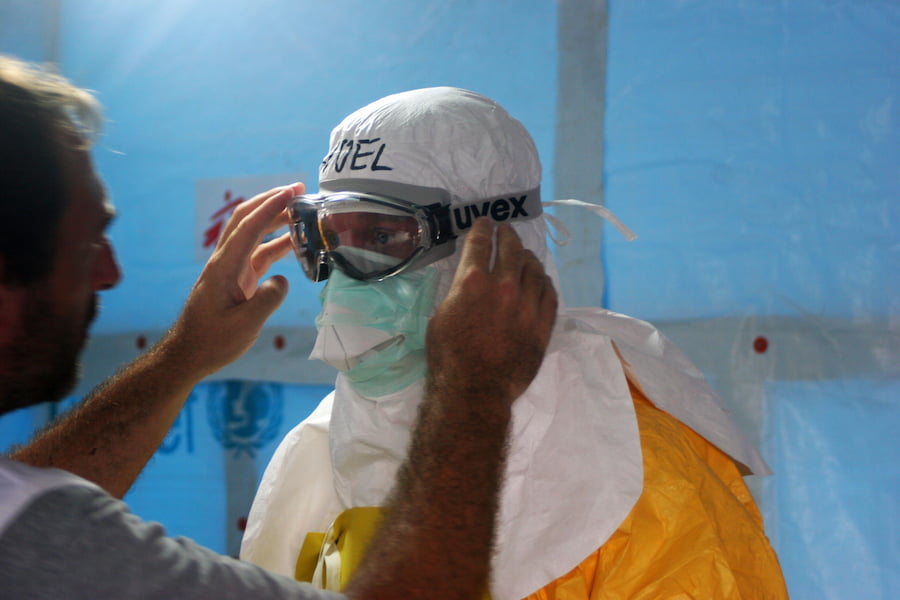
As McCullough points out in his interview with Grant Stinchfield, “It is the pharmaceutical industry’s playbook of manufacturing fear to prime populations for product acceptance.” He points out that the WHO began discussing Ebola vaccine approval roughly four weeks before the outbreak announcement hit headlines, describing the relationship as the WHO working “hand in glove with vaccine companies.” He concludes that, “The grim hazmat-suit imagery flooding the media serves a deliberate purpose: conditioning public consent for an intervention already queued up.”
So, once again, we are seeing the usual exploitation of this latest declared ‘public health emergency of international concern’ – and this was to be expected. What we didn’t expect was recent evidence coming to light that this might not be a viral disease at all and could instead be poisoning related to the open-cast mining that is carried out throughout the ‘Ebola region.’
Jamie Andrews from the Virology Controls Studies Project has proposed (with a great deal of convincing scientific argument too I might add), that many of the diagnosed cases of Ebola coming out of the DRC are more likely to be arsenic and heavy metal poisoning. The source of this poisoning he proposes is the numerous, poorly managed and unregulated open cast mining operations in the area, which use excessive amounts of cyanide in their extraction processes.
The symptoms of Ebola (including the Bundibugyo strain) are: fever; vomiting; diarrhea; abdominal pain; headaches; fatigue; bleeding and hemorrhaging; skin changes and rashes; neurological symptoms and respiratory issues. Every single one of these are also known and documented symptoms of arsenic poisoning. You can read Andrews’ rationale for this in his very detailed and well-referenced two-part series on ‘The Ebola Hoax’ on his substack at the links below.
If Andrews’ hypothesis is correct, it certainly won’t be the first time we have been misled when it comes to pandemics, disease outbreaks and the gold-rush to “find a cure.” But why this time?
Well, when you consider the financial squeeze that the World Health Organization is under since the withdrawal of the United States and all their funding, it becomes a bit more obvious.
It seems that the back-story might be an intentional leveraging of the situation to help recover the hundreds of millions of dollars that have been withdrawn from the WHO’s operating budget as a result of Donald Trump’s withdrawal. This was reiterated by Robert Buraga, a WHO manager in the DRC, who was widely reported as saying that, “Recent cuts of USA funds to WHO, USAID and some universities and research institutions may have negative consequences on the efforts to get a cure or a vaccine,” It is an emotional plea that puts substantial political pressure on the United States and paints them as being both heartless and ultimately responsible for the unconfined outbreak.
However, America has committed significant financing to help manage and curb this outbreak. The U.S. State Department said on Wednesday (June 10th 2026) that they would provide an additional $20 million to help fight the Ebola outbreak in Africa, bringing its total direct support to more than $220 million. They just haven’t given the money to the World Health Organization, so it has gone largely unreported.
Once again, when you delve into the depth of this story, there is so much intrigue, politics, vying for money and, more often than not, lies and deception that it detracts from the human tragedy playing out in those remote corners of Africa. And according to all the evidence, that is where Ebola will remain – in remote corners of Africa. At this stage, we certainly do not need to be worried about Ebola threatening us here in Canada.
The disease just doesn’t work that way, and even if it did, it is very easy to protect yourself from it.
As Dr. Peter McCullough explains on his ‘Focal Points’ substack, “The core mechanisms of Ebola transmission remain persistent and manageable through fundamental hygiene practices. Ebola is an infectious dysentery and is not airborne; it is transmitted primarily through direct contact with the bodily fluids of moribund or deceased patients. Consequently, the most effective “interventions” are the same ones for cholera and dysentery including rigorous implementation of basic sanitation: hand-washing with soap, the safe handling and burial of the deceased, and the meticulous cleaning of contaminated surfaces.”
It’s not that complicated and certainly doesn’t warrant any sort of public health scare or mass panic.
As usual, you should ignore the headline-hype and confidently and contently get on with your day.
Alan Brough
Sources for this article include:
https://childrenshealthdefense.org/defender/ebola-identified-nearly-50-years-ago-no-treatments-for-latest-outbreak/
https://www.who.int/news/item/17-05-2026-epidemic-of-ebola-disease-in-the-democratic-republic-of-the-congo-and-uganda-determined-a-public-health-emergency-of-international-concern
https://childrenshealthdefense.org/defender/critics-question-60-million-push-ebola-vaccines-built-covid-era-platforms-john-campbell/
https://controlstudies.substack.com/p/the-ebola-hoax
https://controlstudies.substack.com/p/the-ebola-hoax-part-2
https://www.thefocalpoints.com/p/the-bedrock-of-containment-why-sanitation
https://www.thefocalpoints.com/p/ebola-hype-how-the-who-manufactures
https://www.usnews.com/news/world/articles/2026-06-10/us-announces-additional-20-million-for-ebola-response